



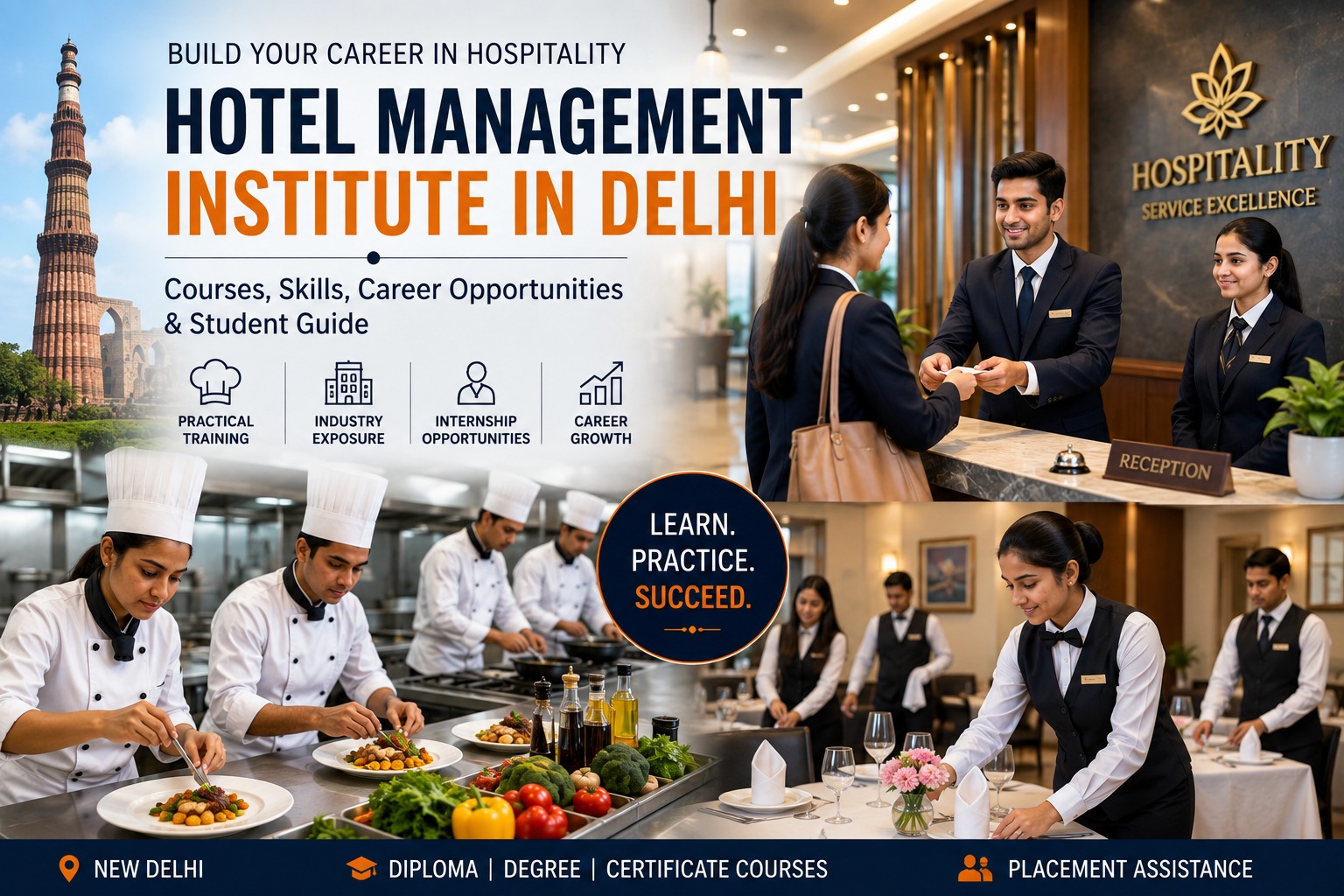
Choosing a career after Class 12 is an important decision. For students who enjoy working with people, food, travel, service, events and dynamic professional environments, hospitality can be an interesting career path to explore.
Delhi is one of the major education and hospitality hubs in India, which is why many students and parents search for a hotel management institute in Delhi when exploring career options after school.
However, choosing an institute should involve more than comparing advertisements or course fees. Students should understand the type of course they want to pursue, the practical training available, industry exposure, internships, facilities, qualification structure and career support before making an admission decision.
This guide explains what students should look for in a hotel management institute in Delhi, the courses they can consider, the skills they can develop and the career opportunities available after completing their hospitality education.
Why Consider Hotel Management After 12th?
Hotel management is no longer limited to traditional hotel jobs. The hospitality sector includes hotels, resorts, restaurants, catering companies, cruise lines, tourism businesses, events, food-service organizations and several other service-oriented industries.
Students who choose hospitality education can develop a combination of technical, operational and interpersonal skills.
A typical hotel management education may introduce students to areas such as:
- Food Production
- Food & Beverage Service
- Front Office Operations
- Housekeeping
- Bakery and Confectionery
- Guest Relations
- Hotel Operations
- Hospitality Management
- Communication
- Professional Grooming
- Customer Service
- Teamwork and Leadership
This makes hotel management suitable for students with different interests. Someone interested in cooking may prefer food production or culinary studies, while another student may be more interested in guest relations, hotel operations, restaurant management or front office.
Why Delhi Is an Important Destination for Hospitality Education
Delhi offers students access to a large hospitality ecosystem.
The city and surrounding NCR region have luxury hotels, business hotels, restaurants, resorts, banquet facilities, travel companies, event organizations and airport-related hospitality operations.
Delhi is also home to a major international airport and has strong connectivity with domestic and international destinations. This creates a useful environment for students who want to understand how hospitality businesses operate in a competitive market.
For a student, studying at a hotel management institute in Delhi can therefore provide opportunities to combine classroom education with practical learning, industry interactions, hotel visits, internships and professional exposure.
The location of an institute is worth considering, but students should also evaluate the quality of its education and training rather than choosing a college simply because it is located in Delhi.
What Courses Can Students Pursue in Hotel Management?
There is no single route into the hospitality industry. Students can choose different programs depending on their academic background, career objectives, preferred specialization and desired duration of study.
Diploma in Hotel Management
A diploma in hotel management can be suitable for students who want focused and practical hospitality education.
Diploma programs generally introduce students to core hotel departments and operational skills. Before enrolling, students should check the course curriculum, practical exposure, internship structure and recognition of the qualification.
Degree in Hotel Management
Students who want an undergraduate-level academic pathway can consider a degree in hotel management or a related hospitality program.
A degree can provide broader academic exposure while also developing professional hospitality skills. Students should check the awarding university, eligibility criteria, curriculum, duration and progression opportunities before choosing a program.
Foundation and Hospitality Operations Courses
Foundation-level programs can help students understand the fundamentals of hotel and hospitality operations.
These courses may introduce students to professional communication, service standards, hotel departments, food and beverage operations and other basic hospitality concepts.
Food Production Courses
Students who have a strong interest in cooking and professional kitchens can explore a food production course.
Food production education can cover areas such as kitchen operations, cooking methods, food preparation, hygiene, ingredients, professional equipment and kitchen management.
Culinary Arts Courses
Culinary-focused programs are another option for students who want to build careers around professional cooking, restaurants, hotels, bakeries, catering and food businesses.
Students should compare the amount of practical kitchen training included in each program before making a decision.
How to Choose a Hotel Management Institute in Delhi
Finding a suitable hotel management institute in Delhi requires students to look beyond the name of the institute.
The following factors can help students make a more informed comparison.
1. Check the Course Curriculum
Start by understanding what the course actually teaches.
A strong hospitality curriculum should provide exposure to the major operational areas of the industry and should also include professional skills such as communication, teamwork, customer service and workplace discipline.
Students should compare the subjects, practical modules, duration and specialization options before admission.
2. Prioritize Practical Training
Hospitality is a hands-on industry.
Reading about food production, restaurant service or front-office operations is different from actually performing these tasks.
Students should therefore look for institutes that provide dedicated practical facilities and regular hands-on sessions.
Training facilities may include:
- Food production kitchens
- Bakery and confectionery laboratories
- Restaurant training areas
- Front-office simulations
- Housekeeping training facilities
- Food and beverage service areas
- Mock bar facilities
Practical training can help students develop confidence before entering an actual hotel or hospitality workplace.
3. Look for Industry Exposure
Students should ask how an institute connects classroom education with the hospitality industry.
Useful forms of industry exposure can include:
- Hotel visits
- Guest lectures
- Industry workshops
- Culinary demonstrations
- Hospitality seminars
- Live activities
- Industrial training
- Internships
- Interaction with hospitality professionals
Such experiences can help students understand professional expectations and workplace standards.
4. Understand the Internship Program
An internship can be one of the most valuable components of hospitality education.
It allows students to experience the working environment of a hotel or other hospitality organization and apply classroom knowledge in real situations.
Before admission, students should ask:
- Is an internship included in the course?
- How long is the internship?
- Which departments can students experience?
- Does the institute assist with internship opportunities?
- What types of hospitality organizations participate?
The answers can help students understand the practical value of a program.
5. Evaluate Training Facilities
Students should visit the campus if possible.
Instead of relying only on photographs or advertisements, they should see whether the institute has appropriate facilities for practical learning.
A well-equipped hospitality campus can provide students with opportunities to repeatedly practice operational skills before entering the industry.
6. Consider Faculty and Industry Professionals
Experienced teachers can help students understand both theoretical concepts and practical workplace requirements.
Students should also look for institutes that invite industry professionals for guest lectures, workshops and demonstrations.
Interaction with professionals can give students a better understanding of current hospitality practices and career expectations.
7. Compare Course Fees Carefully
Hotel management course fees can vary according to the institute, course duration, qualification, facilities, practical training and other components.
Students should not automatically choose the cheapest course.
Instead, compare what the fee includes, such as:
- Tuition
- Practical training
- Laboratory facilities
- Training materials
- Internship support
- Industry exposure
- Career preparation
- Other academic or institutional charges
Understanding the complete fee structure before admission can prevent confusion later.
8. Check Career and Placement Support
Career support is another important consideration.
Students can ask whether the institute provides:
- Resume preparation
- Interview preparation
- Grooming sessions
- Communication training
- Mock interviews
- Employer interactions
- Campus recruitment
- Career counselling
- Internship assistance
Students should also understand the difference between placement assistance and a guaranteed job. Employment ultimately depends on factors such as eligibility, skills, interview performance and employer requirements.
What Skills Do Students Develop During Hotel Management?
A good hospitality program should help students develop both technical and interpersonal skills.
Technical Skills
Depending on the course, students may learn:
- Food preparation
- Kitchen operations
- Food safety
- Restaurant service
- Front-office procedures
- Housekeeping operations
- Guest service
- Hotel operations
- Bakery and confectionery
- Basic hospitality management
Professional Skills
Hospitality professionals also need strong interpersonal abilities.
Students can develop:
- Communication
- Teamwork
- Leadership
- Problem-solving
- Time management
- Professional grooming
- Customer handling
- Confidence
- Adaptability
- Workplace discipline
These skills can be useful not only in hotels but also in restaurants, tourism, events, cruise hospitality and other customer-focused industries.
The Hotel School, New Delhi: An Institute Students Can Explore
Students researching a hotel management institute in Delhi can also explore The Hotel School, New Delhi.
The institute has been providing hospitality-focused education since 2006 and is located near IGI Airport and Aerocity in New Delhi.
Its programs include hotel management, hospitality management, food production, culinary-focused education and degree pathways. The institute combines classroom learning with practical sessions, workshops, assignments and industry exposure.
The Hotel School’s campus includes dedicated practical facilities for areas such as food production, bakery, front office, housekeeping and food and beverage service.
For students, this type of learning environment can provide opportunities to develop operational knowledge while gaining confidence in practical hospitality activities.
The institute also highlights industrial training, internships, industry interactions and career support as components of its student development approach.
Students considering The Hotel School should review the specific course structure, eligibility, duration, fees and career opportunities for the program they are interested in before applying.
Why Practical Learning Matters in Hospitality
Hospitality is different from many purely academic disciplines because professional performance depends heavily on practical skills.
A student may understand the theory behind guest service, food preparation or front-office operations, but professional confidence develops through repeated practice.
For example, a student working in a training kitchen can learn how to organize a workstation, follow hygiene procedures, prepare food and work as part of a kitchen team.
Similarly, front-office simulations can help students understand guest communication, professional etiquette and basic operational procedures.
This is why students comparing hotel management courses in Delhi should pay close attention to how much practical learning is included in each program.
Career Scope After Hotel Management
Hotel management can open career opportunities across several areas of the hospitality and service industry.
Depending on their education, specialization, skills and experience, graduates may explore roles in:
- Hotels
- Resorts
- Restaurants
- Food and beverage operations
- Front office
- Guest relations
- Housekeeping
- Food production
- Bakery and confectionery
- Catering
- Cruise hospitality
- Airport hospitality
- Tourism
- Event management
- Banquet operations
- Travel-related businesses
Students interested in culinary careers can focus on food production and kitchen operations, while students who enjoy interacting with guests may prefer front office or guest relations.
Over time, professionals can progress from entry-level operational positions into supervisory, managerial and specialized roles as they gain experience.
Can Hotel Management Students Build International Careers?
Hospitality is a global industry, and qualified professionals can explore opportunities outside India as well.
Hotels, resorts, cruise companies and international hospitality businesses recruit professionals with appropriate qualifications and skills.
However, international employment should not be viewed as automatic. Opportunities depend on factors such as the student’s skills, qualification, employer selection, job requirements, work authorization and immigration regulations.
Students who are interested in international careers should therefore focus on developing strong practical skills, communication abilities, professional behaviour and relevant industry experience.
Questions Students Should Ask Before Taking Admission
Before selecting a hotel management institute, students and parents should ask:
What is the duration of the course?
Understand the complete academic and practical schedule.
What qualification will I receive?
Check the awarding or certifying organization and progression opportunities.
How much practical training is included?
Ask specifically about kitchens, restaurants, front-office simulations and other training facilities.
Does the course include an internship?
Find out the duration, structure and internship assistance available.
What are the complete fees?
Ask for a detailed fee structure instead of relying only on an advertised starting price.
What career support does the institute provide?
Understand the placement assistance, recruitment activities and career preparation available.
Can I visit the campus before admission?
A campus visit can help students evaluate the learning environment and practical facilities themselves.
Frequently Asked Questions
Which is the best hotel management institute in Delhi?
There is no single institute that is automatically the best choice for every student. The right choice depends on the student’s course preference, career goals, budget, practical training requirements, qualification and desired specialization. Students should compare institutes using these factors rather than relying solely on rankings or advertisements.
What should I look for in a hotel management institute in Delhi?
Students should compare curriculum, practical training, faculty, training facilities, industry exposure, internships, qualification, fees, career support and location. These factors provide a more complete picture of the learning experience.
Which hotel management courses are available after 12th?
Students can explore diploma programs, degree programs, foundation courses, hospitality operations programs, food production courses and culinary-focused programs. Eligibility and course structure vary between institutes.
Is a diploma in hotel management a good option after 12th?
A diploma can be suitable for students who want focused hospitality education with practical exposure. Students should compare the course duration, curriculum, practical training, internship opportunities and recognition before choosing a program.
What is the difference between a hotel management diploma and degree?
A diploma generally provides focused professional training, while a degree provides a broader undergraduate-level academic qualification. The right option depends on the student’s long-term academic and career objectives.
What are the hotel management course fees in Delhi?
Fees vary by institute, course, duration, facilities and qualification. Students should request the complete fee structure and understand which academic and practical components are included.
Is hotel management a good career after 12th?
Hotel management can be a suitable career option for students interested in hospitality, food, travel, customer service and dynamic work environments. Success depends on developing practical skills, communication, discipline, adaptability and professional experience.
Can hotel management students work in cruise lines and international hotels?
Yes, hospitality graduates can explore careers in cruise lines, international hotels, resorts and other global hospitality organizations. Individual opportunities depend on qualifications, skills, recruitment requirements and work authorization.
Why is practical training important in hotel management?
Hospitality is a hands-on profession. Practical training allows students to apply concepts, develop technical skills, understand workplace procedures and build confidence before entering the industry.
Final Thoughts for Students
Choosing a hotel management institute in Delhi should be treated as a career decision rather than simply an admission decision.
Students should look beyond promotional claims and compare what they will actually experience during the course.
A good hospitality education should bring together academic knowledge, practical training, industry exposure, professional development and opportunities to understand the real working environment.
Students should compare multiple institutes, visit campuses where possible, speak with admission counsellors, understand the complete fee structure and carefully review the course they intend to pursue.
For students who enjoy hospitality, food, travel, service and working with people, hotel management can provide a wide range of career possibilities.
The right institute can help turn that interest into practical skills, professional confidence and a foundation for a long-term career in the hospitality industry