

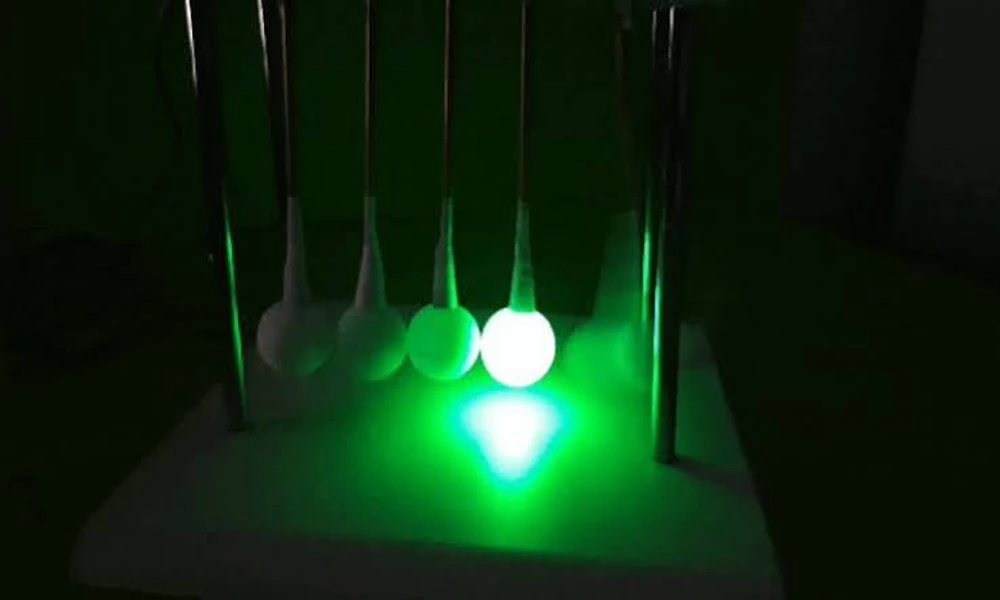
These Newton’s Cradle simulator tools are an ideal revision aid for secondary school students mastering forces, collisions, and energy transfer. Instead of memorising static textbook diagrams, learners can experiment with symmetrical drop patterns to see how momentum and kinetic energy remain conserved across every impact. Users can isolate momentum readouts, focus purely on kinetic energy, or display both side by side while using pause and slow-motion features to study each collision step by step.
Newton’s cradle simulator is an excellent demonstration of pendulum motion and mechanical oscillation, with the added complexity of collisions between neighbouring spheres. Each suspended sphere behaves approximately like a simple pendulum while swinging freely. Gravity pulls it towards its lowest point, while the suspension constrains its path along an arc. When released from a raised position, the ball accelerates downward, passes through equilibrium and then interacts with the rest of the apparatus.
In a single pendulum, students can study gravitational potential energy, kinetic energy, periodic motion and the influence of pendulum length on oscillation period. A Newton’s cradle extends these ideas by showing how repeated impacts interrupt and redistribute the motion. The familiar back-and-forth sequence is not merely one pendulum swinging indefinitely; it is a succession of free swings and short collisions that transfer momentum and energy between different balls.
The apparatus is also valuable for teaching damping and energy dissipation. Each cycle is affected by imperfect collisions, air resistance, friction and vibrations, causing the visible swinging amplitude to diminish. Students can measure the height reached after successive impacts or use video analysis to plot the decay in motion. They can then discuss the difference between a theoretical undamped oscillator and a real physical system.
Teachers may use these observations to introduce frequency, amplitude, equilibrium position, restoring forces and mechanical energy. Advanced learners can compare the small-angle pendulum approximation with larger release angles or examine how the collisions complicate a simple sinusoidal description. A particularly useful classroom comparison is to observe a single ball swinging without collisions, then repeat the experiment with the full row in contact. The difference makes clear how coupling through impacts changes the motion students see. The Newton’s cradle simulator tool therefore links familiar physical pendulum physics to a richer study of oscillations, impacts and energy loss in real mechanical systems.
The simulator tool developed by Active Kinetic 1, also helps students understand why perpetual motion does not exist in everyday mechanics. By switching from ideal Simple Harmonic Motion to the Mechanical Contact Decay setting, learners can observe how repeated collisions convert kinetic energy into sound and thermal heat, steadily reducing energy retention. Additionally, the dedicated Paradox Newton’s Cradle feature provides a memorable visual lesson on simultaneous conservation laws, showing how splitting speed across two outgoing Newton’s Cradle balls results in missing kinetic energy.
Newton’s Cradle Simulator
Compare classical mechanical sphere impacts with parallel-face Active Magnetic Cradle (AMC) dipole carriages.
|
Impacts: 0 | Energy Retained: 100.0%